
Japanese Studies Teaching Staff

Dr Brigitte Steger
Dr Brigitte StegerContact Information

Email: bs382@cam.ac.uk
Tel: 01223 335140

Current Position

University Lecturer in Modern Japanese Studies (Society)
Secretary of the Degree Committee and Director of Graduate Affairs

Fellow of Downing College
AMES Director of Studies at Downing College and Sidney Sussex College

Biographical Details

Brigitte Steger is Austrian and earned her Mag. phil. and Dr. phil. degrees in Japanese Studies (with minors in Sociology and Political Science) from the University of Vienna. From 1994-1996 she spent two years at the University of Kyoto conducting research for her doctoral dissertation; in 2002/03, 2006 and 2011 she was visiting researcher at Tokyo’s Meiji, Sophia and Keio Universities. She has many years of teaching and research experience at the University of Vienna, and has also held posts at the University of Pennsylvania in Philadelphia and the Karoli Gaspar University in Budapest. Her teaching mainly deals with the various aspects of Japanese society, with intercultural communication as well as with methodologies and methods in qualitative social science research. She welcomes enquiries to supervise students who are interested in research on the various aspects of Japanese society. She is a member of the Council of the European Association for Japanese Studies (2008-2011, 2011-2014) and of the Japan Anthropology Workshop (since 2008).

Research Interests

Brigitte Steger specializes in Japanese society, with emphasis on the cultural history and anthropology of daily life. In her research, she has always been intrigued by questions of the cultural and social embeddedness of seemingly natural, bodily matters and daily life. Her master’s thesis explored childbirth and midwifery from sociological and political perspectives, especially the incorporation of midwifery into police administration and of the introduction of concepts of hygiene in modern Japan. Her doctoral dissertation dealt with sleep, especially sleeping times. For her doctoral dissertation she was awarded the ‘Bank Austria Prize 2002 for the Promotion of Innovative Research at the University of Vienna’, and the published book, (Keine) Zeit zum Schlafen? Kulturhistorische und sozialanthropologische Erkundungen japanischer Schlafgewohnheiten. (Münster: LIT 2004) earned her the ‘Science Award of the Federal State of Vorarlberg, Austria, 2005, Special Award for an Outstanding Publication’. Consequently she was also nominated as ‘Austrian of the Year’ at the ‘Austria 2005’ awards ceremony in the category of science and research. Her book Inemuri (Rowohlt, 2007) was published in braille in 2008 and is currently being translated into Japanese, to be published at Hankyu Communications in early summer 2013. She is also preparing two monographs on the cultural history of sleep in Japan and on the anthropology of sleep.

Steger is also working on a history of how day and night are timed. In particular, she investigates how people in pre-modern Japan dealt with the marshalling of time according to daily schedules. This study aims to provide a tool for understanding how time consciousness prepared the Japanese for the industrialisation and modernisation that occurred after the re-opening of the country in the second half of the nineteenth century. It thus aims to add to the discussion on work ethics and modernisation. Furthermore, the Japanese history of timing could potentially challenge existing theories in the cultural history of time and the hour deduced from research conducted in Europe and the USA.

Teaching

Undergraduates

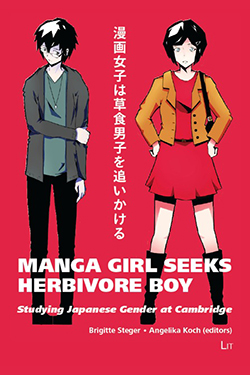
Steger supervises a number of undergraduate dissertations on contemporary Japanese society each year. A collection of undergraduate dissertations on gender issues is currently in print. The book will be presented to the public on 23 February 2013.

Brigitte Steger and Angelika Koch (eds):
Manga girl seeks herbivore boy: Studying Japanese gender at Cambridge.  Münster et al.: Lit

Graduates

Steger welcomes inquires from talented young scholars to work under her supervision. She is willing and able to supervise a wide range of topics related to Japanese society that are based on fieldwork.

Current graduate students:

Gitte Hansen (advisor 2008-2011, supervisor since 2011)
Angelika Koch (advisor; acting supervisor in Lent and Easter terms 2009)
Meng Liang (supervisor)
Hiroko Umegaki Constantini (supervisor)

Publications

Books and edited volumes

2013   Japan copes with calamity. Ethnographies of the earthquake, tsunami and nuclear disasters of March 2011. Edited with Tom Gill and David Slater. Oxford: Peter Lang (in print).

2013   Inemuri. Tōkyō: Hankyū Communications (work title; in print)

2013   Daisaigo to mukiau. Edited with Tom Gill and David Slater. Kyōto: Jinbun Shoin (in print; March)

2013   Manga girl seeks herbivore boy. Studying Japanese gender at Cambridge. Edited with Angelika Koch. Münster et al.: LIT, 230 pp.

2008   Worlds of sleep. Edited with Lodewijk Brunt. Berlin: Frank & Timme, 252 pp.

2007   Inemuri. Wie die Japaner schlafen und was wir von ihnen lernen können. Reinbek bei Hamburg: Rowohlt. Published in Braille 2008, 235 pp.

2006   Timing daily life in contemporary Japan = special issue ed. for Time & Society 15/2-3, 171-249.

2004   (Keine) Zeit zum Schlafen? Kulturhistorische und sozialanthropologische Erkundungen japanischer Schlafgewohnheiten [(No) time to sleep? – Cultural history and social anthropology of Japanese sleep habits]. Münster et al.: LIT  (1st edition Jan., 2nd rev. edition Oct.), 504 pp.

2003   Night-time and Sleep in Asia and the West: Exploring the dark side of life. Edited with Lodewijk Brunt. London: RoutledgeCurzon. paperback: Vienna: University of Vienna 2006, 226 pp.

Academic articles in refereed journals and academic edited volumes

2013 ‘Solidarity and distinction through practices of cleanliness in tsunami evacuation shelters in Yamada, Iwate Prefecture’, Tom Gill, Brigitte Steger and David Slater (eds): Japan copes with calamity. Ethnographies of the earthquake, tsunami and nuclear disasters of March 2011., March 2011. Oxford: Peter Lang (in print).

2013   ‘Introduction: Ethnographies of the 3.11 Disasters’, with David Slater and Tom Gill; Tom Gill, Brigitte Steger and David Slater (eds): Japan copes with calamity. Ethnographies of the earthquake, tsunami and nuclear disasters of March 2011.. Oxford: Peter Lang (in print).

2013   ‘The 3.11 Disaster’, with Tom Gill and David Slater; Tom Gill, Brigitte Steger and David Slater (eds): Japan copes with calamity. Ethnographies of the earthquake, tsunami and nuclear disasters of March 2011, March 2011. Oxford: Peter Lang (in print).

2013   ‘“Mina issho dakara” Iwate-ken, Yamada-machi no tsunami hinanjo no rentaikan’, Tom Gill, Brigitte Steger and David Slater (eds): Daisaigo to mukiau. Kyoto: Shinbun Shoin (in print).

2013   ‘Introduction’, Tom Gill, Brigitte Steger and David Slater (eds): Daisaigo to mukiau. Kyoto: Shinbun Shoin (in print).

2013   with Angelika Koch: ‘Introduction: Gender matters’, Brigitte Steger and Angelika Koch (eds): Manga girl seeks herbivore boy. Studying Japanese Gender at Cambridge. Muenster et al.: LIT, 1-18.

2012   ‘“We were all in this together”. Challenges to and practices of cleanliness in tsunami evacuation shelters in Yamada, Iwate Prefecture, 2011’, Japan Focus, 17 September. (12,000 words)

2012   ‘Cultures of sleep’, in: Sleep: Multi-professional perspectives, ed. by Andrew Green and Alex Westcombe. London: Jessica Kingsley Publishers, 68–85.

2011   ‘Kulturkreis’ with Andre Gingrich, in: Lexikon der Globalisierung, ed. by Fernand Kreff, Eva-Maria Knoll and Andre Gingrich (2011 eds). Bielefeld: [transcript], 217–220.

2010   ‘Comment on Galinier and Becquelin eds. et al.: “Anthropology of the Night: Cross-Disciplinary investigations”,’  Current Anthropology 51/6, 840–841.

2008   ‘Early to rise: Making Japanese healthy, wealthy, wise, virtuous, and beautiful’, in: Worlds of sleep, ed. by Lodewijk Brunt and Brigitte Steger. Frank & Timme, 211–235.

2008   ‘Introduction’ with Lodewijk Brunt, in:  Worlds of sleep, ed. by Lodewijk Brunt and Brigitte Steger. Frank & Timme, 9–30.

2008   ‘Inemuri to tanuki neiri’, in: Suimin bunka o manabu hito no tame ni [university textbook for the sociology of sleep], ed. by Takada Masatoshi, Horii Tadao and Shigeta Masayuki. Kyoto: Sekai Shisōsha, 90–91.

2006   ‘Introduction: Timing daily life in Japan’, Timing Daily Life in Contemporary Japan = Time & Society  15/2-3 (October), 171–175.

2006   ‘Napping through class to success. Japanese notions of time and diligence’, Time & Society (October), 197–214.

2006   ‘Normalizing the workplace nap: blurring the boundaries between public and private space and time’, with Steve Kroll-Smith, Journal of Sleep Research 15 (Suppl.1), 3.

2006   ‘Getting smart by napping in class: making sense of Japanese high school students’ sleep patterns’, Journal of Sleep Research 15 (Suppl. 1), 3–4.

2005   ‘Schlafen. Nicht Arbeit, nicht Freizeit, aber …’, in: Über Japan denken. Japan überdenken. Festschrift für Sepp Linhart zu seinem sechzigsten Geburtstag von seinen Schülerinnen und Schülern, ed. by Roland Domenig, Susanne Formanek and Wolfram Manzenreiter. Münster et al.: LIT, 233–255.

2005   ‘Creating free time, creating positive energy. Why Japan rises early,’ Paideuma 51, 181–192.

2003   ‘Getting away with sleep. Social and cultural aspects of dozing in Parliament,’ Social Science Japan Journal 6/2 (October), 181–197.

2003   ‘Infōmaru na katsudō toshite no inemuri. Kokkai giin no inemuri ronsō o kangaeru’ (Sleep as an informal beaviour. The inemuri debate in Parliament), in: Nihon no soshiki no jinruigaku. ed. by Nakamaki Hirochika and Mitchell Sedgwick. Tōkyō: Tōhō Shuppan, 325–343.

2003   ‘Negotiating Japanese sleep patterns,’ in: Night-time and Sleep in Asia and the West: Exploring the dark side of life, ed. by Brigitte Steger and Lodewijk Brunt. London: RoutledgeCurzon, 65–86.

2003   ‘Introduction: Into the night and the world of sleep,’ with Lodewijk Brunt, in Night-time and Sleep in Asia and the West: Exploring the dark side of life, ed. by Brigitte Steger and Lodewijk Brunt. London: RoutledgeCurzon, 1–23.

2002   ‘Schlafen als Forschungsgegenstand der sozialwissenschaftlich orientierten Japanologie’ (‘Sleep as a research topic in Japanese Studies’), Japanforschung – Mitteilungen der Gesellschaft für Japanforschung 2, 6–20.

1998   ‘Kodaijin wa itsu neteita ka’ (‘The administration of sleeping time in ancient Japan’), in: Nihonjin no rōdō to asobi: rekishi to genjō, ed. by Sepp Linhart and Inoue Shō’ichi. Kyōto: Nichibunken, 13–33.

1997   ‘Die Modernisierung der Geburtshilfe vom unreinen Gewerbe zum Karriereberuf oder Die Dissemination staatlicher Kontrolle ins Private’ (‘The Modernisation of midwifery from an ‘impure trade’ to a career, or the dissemination of state control to private enterprise’), in: Getrennte Welten, gemeinsame Moderne? Geschlechterverhältnisse in Japan, ed. by Ilse Lenz and Michiko Mae.Opladen: Leske und Budrich, 150–178.

1996   ‘Tabi no negurashi – ryokōchū no nemuri no bunka’ (‘Travel as lullaby. The culture of sleep in travelling Japan’), in Tabi no bunka kenkyūjo (ed.) Tabi no bunka kenkyūjo hōkoku, Tōkyō, Vol. 4 (December), 119–130.

1994   ‘From Impurity to Hygiene: The Role of Midwives in the Modernisation of Japan,’ Japan Forum, 2 (October), 175–187.

1994   ‘Fujinkai – Javanese Women under Japanese Occupation: Including some comments from Idrus’ short story,’ in: Traditional and modern in Japanese literature and language, ed. by the P. Centrum Roznov for the Japan Center Prague. Prague, 61–71.

1994   ‘Frauen im Krieg – Erfahrungen mit lebensgeschichtlichen Interviews’ (‘Women in War – experiences in life history interviews’), in: Sozialwissenschaftliche Methoden in der Ostasienforschung, ed. by Sepp Linhart, Erich Pilz and Reinhard Sieder, Vienna: Beiträge zur Japanologie 32, 105–118.

Other research articles

2013   ‘Still missing… ’, Tom Gill, Brigitte Steger and David Slater (eds): Japan copes with calamity. Ethnographies of the earthquake, tsunami and nuclear disasters of March 2011. Oxford: Peter Lang (in print).

2013   ‘Kachan dete konai’, Tom Gill, Brigitte Steger and David Slater (eds): Daisaigo to mukiau. Kyōto: Jinbun Shoin (in print).

2011   ‘Secrets in a tsunami evacuation center’, Anthropology News (14 November) 52(8), 2 pp.

2009   ‘Wie man sich bettet, so schläft man – Der Futon’, in: Reise nach Japan. Edited by Francoise Hauser. Zürich: Unionsverlag, 184-189.

2009   ‘Schlafen – Zwischen Geistesblitz und Zeitverschwendung’, in: Entschleunigung: Die Entdeckung der Langsamkeit, ed. by Globart Academy. Wien and New York: Springer, 39-49.

2007   ‘Wie die Japaner schlafen, und was wir von ihnen lernen können’, Brücke 2/, 8-10.

2003   ‘Die Vierstundenschlaf-Methode und andere Schlaftrends in Japan’ (‘Recent sleeping trends in Japan’), Informationen des Akademischen Arbeitskreises Japan. Minikomi 67, 5–9.

2003   ‘Nemuri no bunka. Kokkai giin no inemuri ronsō o kangaeru’ (‘Sleeping culture. Thinking about the debate on inemuri of the Parliamentarians’), Meiji Daigaku Bungakubu (ed.) Meiji Daigaku Bungakubu, Uiin Daigaku Jinbun kagakubu gakujutsu kyōtei teiketsu kinen kōenkai oyobi kokusai kenkyū happyōkai kiroku March, 2–19.

2003   ‘Inemuri suru Nihonjin’ (‘Napping Japanese’), Sensho mechie henshūbu (ed.): Nippon wa omoshiroi ka (Is Japan interesting?). Tōkyō: Kōdansha (= Kōdansha sensho mechie), 84–97.

2002   ‘Schlafen in Japan (1): ‘Inemuri’ – Nickerchen in der Öffentlichkeit’, dieUniversität.at – Science goes public. July 25. www.univie.ac.at/dieuniversitaet/2002/science

2002   ‘Schlafen in Japan (2): Die Freiheit beginnt mit geschlossenen Augen’, dieUniversität.at – Science goes public. July 26. www.univie.ac.at/dieuniversitaet/2002/science

2002   ‘Schlafen in Japan (3): Sind JapanerInnen in Wahrheit faul?’, dieUniversität.at – Science goes public. July 30. www.univie.ac.at/dieuniversitaet/2002/science

2001   ‘Jūkyūseki Edo to Uiin ni okeru “yoru” to “nemuri” / Nachtzeit und Schlafkultur in Edo/Tokyo und Wien’, Mitteilungsheft: Gemeinsames Symposium der Meiji Universität Tokyo und der Universität Wien 25. –26. 1. 2001 (in Japanese with a German summary), 21–28.

2000   ‘Nihonjin wa naze densha no naka de nemuru no ka’ (‘Why do Japanese sleep in the train’), is 84 (September), 6–9.

2000   ‘Neunundzwanzig Ansichten von der Nacht’ (‘Twenty-nine views of the night’), Informationen des Akademischen Arbeitskreises Japan. Minikomi 4/, 5–11.

1999   ‘Warten auf Kōshin – Theorie und Praxis eines japanischen Festes’ (‘The theory and reality of the Kōshin-machi’), Informationen des Akademischen Arbeitskreises Japan. Minikomi 4, 5–9.

1998   ‘Angewandte Anthropologie: Schlafend zu Gast bei einer japanischen Familie’ (Understanding sleeping habits during a homestay in a Japanese family), Informationen des Akademischen Arbeitskreises Japan. Minikomi 4, 23–25.

1998   ‘Wann schläft Japan? Zur Kultur des Schlafens außerhalb der Schlafstatt’ (‘On the culture of sleep outside the sleeping place’),: Referate des 10. Deutschprachigen Japanologentages vom 9. bis 12. October 1996 in München, ed. by Peter Pörtner, Josef Holzapfel and Ulrich Apel. Munich: Iudicium, 240–245.

1997   ‘Nihonjin no nemuri no jikan sokutei’ (‘Measuring sleeping time of the Japanese’), in Keihanna (ed.) Keihanna marason semina: Ningen, seibutsu, jikan – samazama na jikan o motomete, dai 8 kai kenkyūkai kiroku, Kyōto 1996, 6–11.

1993   ‘Fude oroshi – den Pinsel spitzen’ (‘On the first sexual experience’), Informationen des Akademischen Arbeitskreises Japan. Minikomi 1/2, 6–7.

1993   ‘Japanische Besatzung aus der Sicht eines Indonesiers’ (‘Japanese Occupation as seen through the eyes of an Indonesian’), Informationen des Akademischen Arbeitskreises Japan. Minikomi 1/2, 5–6.

Conference reports, teaching reports, book reviews, etc

2013   /Book review/ ‘Matthew Wolf-Meyer: The slumbering masses. Sleep, medicine, and modern American life (2012)’, Bulletin of the History of Medicine. (in print)

2013   ‘Preface and Acknowledgements’, Brigitte Steger and Angelika Koch (eds): Manga girl seeks herbivore boy: Studying Japanese gender at Cambridge. Münster et al.: Lit.

2009   /Book review/ ‘Eluned Summers-Bremner: Insomnia. A cultural history (2008)’, Bulletin of the History of Medicine  83, 385-386.

2007   ‘Komplexes einfach zu präsentieren zwingt zum genauen Denken’, Heureka! 1, 15.

2006   /Book review/ ‘Simon Williams: Sleep and society. Sociological ventures into the (un)known’, Sociological Inquiry 76/4, 528–529.

2006   ‘Summary Notes: JAWS Career Development Forum’, JAWS Newsletter, 9-10.

2006   ‘Report on the 17th conference of the Japan Anthropology Workshop (JAWS), concurrent with Section 5, Anthropology and Sociology of the 11th conference of the European Association for Japanese Studies’, JAWS newsletter (April), 11-12.

2005   ‘[The 11th International Conference of EAJS at Vienna. Conference Report.] Section 5: Anthropology and Sociology’, EAJS Bulletin 70 (December), 16–17.

2003   ‘Translating academic research to the public,’ with Pia Vogler, Anthropology News (Newsletter of the American Anthropological Association), March, 22–23.

2003   ‘Preface and Acknowledgement,’ with Lodewijk Brunt, in: Night-time and Sleep in Asia and the West. Exploring the dark side of life, ed. by Brigitte Steger and Lodewijk Brunt. London: RoutledgeCurzon, xi–xii.

2002   ‘Medienarbeit für JapanologInnen’ dieUniversität.at – Science goes public, with Judith Brandner, July 24. www.univie.ac.at/dieuniversitaet/2002/science

2002   ‘Media Work for Students of Japanese Studies,’ with Judith Brandner, IIAS Newsletter 29, 26.

2001   ‘Neue Dissertation: (Keine) Zeit zum Schlafen. Eine japanologisch-sozialwissenschaftliche Studie,’ Informationen des Akademischen Arbeitskreises Japan. Minikomi 1, 39–41.

2001   ‘The “dark side” of life in Asia and the West – Night-time and the time to sleep,’ JAWS Newsletter 33 (April), 16.

2001   ‘The “dark side” of life in Asia and the West: Night-time and the time to sleep,’ with Lodewijk Brunt, IIAS-Newsletter 25, 13.

1997   ‘Jiko shōkai: Work in progress,’ Informationen des Akademischen Arbeitskreises Japan. Minikomi 3, 36.

1996   ‘Gendai Nihon no nemuri’ (‘Sleep in Contemporary Japan’), The Sundial Report, No. 30 (April), 1.

1996   ‘Tabi no negurashi – ryokōchū no nemuri no bunka’ (‘The culture of sleep during travel’), in Dai 2kai tabi no bunka kenkyu forum Dai 2kai tabi no bunka kenkyū fōramu (April), 12–13.