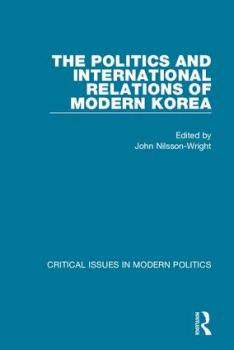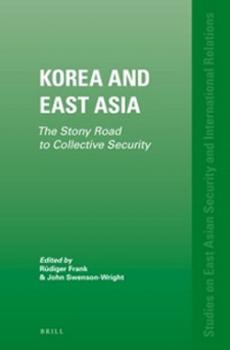
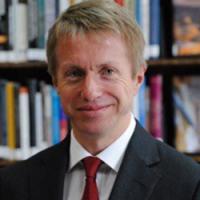
John Nilsson-Wright is the Fuji Bank University Professor of Modern Japanese Politics and the International Relations of East Asia and a Fellow of Darwin College. He read Politics, Philosophy and Economics (PPE) as an undergraduate at Christ Church, Oxford, from 1984 to 1987 during which time he developed an interest in Japanese politics and foreign policy. From 1988 to 1989 he was a Monbusho visiting researcher at Kyoto University, where he worked under the guidance of Professor Masataka Kosaka, focusing on post-war relations between Japan and Korea.
From Japan he moved to the United States, where he completed an M.A. in International Relations (concentrating on East Asian studies) at the Nitze School of Advanced International Studies (SAIS), Johns Hopkins University, in Washington, DC.
In 1991 he returned to Oxford, to St. Antony's college, for his D.Phil. in International Relations under the guidance of Professors Arthur Stockwin and Rosemary Foot. His research focused on early Cold War US-Japan foreign and security relations from 1945 to 1960, and involved extensive archival research both in the United States and in Japan, where he spent a ten month period as a visiting researcher at Tokyo University. His thesis was completed in 1997 and awarded the British International History Group (BIHG) annual dissertation prize.
Alongside his work at FAMES, Dr Nilsson-Wright is head of the Japan and Koreas Programme at the Centre for Geopolitics, POLIS, University of Cambridge.
In addition to his positions at Cambridge, Dr Nilsson-Wright has also been Senior Research Fellow for Northeast Asia and Korea Foundation Fellow at the Asia Programme at Chatham House which he previously directed as Head of Programme from March 2014 to October 2016.
He has been a Monbusho research fellow at Kyoto and Tokyo universities, and a visiting fellow at Tohoku University, Yonsei University, Korea University, and Seoul National University. He has also been a member of the World Economic Forum (WEF) Global Agenda Council (GAC) on Korea, the UK-Korea Forum for the Future, and he is a director of the UK-Japan 21st Century Group. In 2014 he was a recipient of the Nakasone Yasuhiro Prize.
He comments regularly for the global media on the international relations of East Asia, with particular reference to Japan and the Korean Peninsula (see here for a representative selection of recent articles), and has testified to the House of Commons, Foreign Affairs Committee and the House of Commons, Defence Committee.
He is a member of the editorial board of Global Asia, and is a founding member of the European Japan Advanced Research Network (EJARN). He is also a non-residential fellow at the Sejong Institute, Seoul, South Korea; a visiting senior fellow at the Korea Centre, East Asia Institute, National University of Singapore; and a non-resident fellow at the European Centre for North Korean Studies, University of Vienna.
Dr Nilsson-Wright teaches courses relating East Asian politics and international relations, with a particular focus on North and South Korea.
Dr Nilsson-Wright is happy to supervise graduate students who wish to work on East Asian politics, international relations and diplomatic history, particularly with reference to Japan, North and South Korea and US relations with Northeast Asia.
Dr Nilsson-Wright's recent work has continued to concentrate on the Cold War relationship between the United States and Northeast Asia, with particular reference to the security and political relationships between the United States and Japan and the two Koreas, but has expanded to include contemporary regional security issues and political change.
In his policy work, he focuses on regional security and the changing nature of alliance relations in East Asia.
He is currently writing a monograph on populism and identity politics as a contemporary and historical phenomenon in both Europe and Northeast Asia.
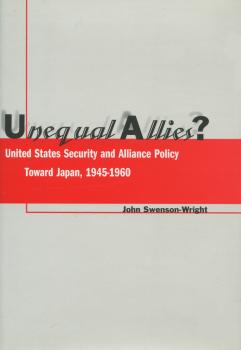
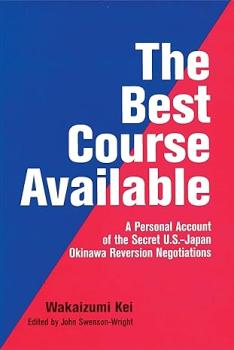
His early work focused on the US-Japan relationship, including a monograph published by Stanford University Press, entitled Unequal Allies? United States Security and Alliance Policy Towards Japan, 1945-1960 (March 2005), as well as an edited translation of a Japanese memoir dealing with the role of Okinawa in bilateral US-Japan relations - The Best Course Available. A Personal Account of the Secret US-Japan Okinawa Reversion Negotiations - written by the late Professor Kei Wakaizumi, and published by Hawai'i University Press in April, 2002.
Current PhD students
| Chae Kyoun Ha: Japan and Korea's Regional Diplomacy vis-à-vis Southeast Asia during the Cold War |
| Risha Roy: The legacies of empire and the emergence of multiculturalism in Japan and South Korea |
| Sang Hun Seok: To be confirmed |
| Jie Yang: Morality in East Asian Politics |
| Gabriella Wangmu Zhaxi: China-North Korean Relations |